Submerged arc welding: process & applications
What is submerged arc welding (SAW)?
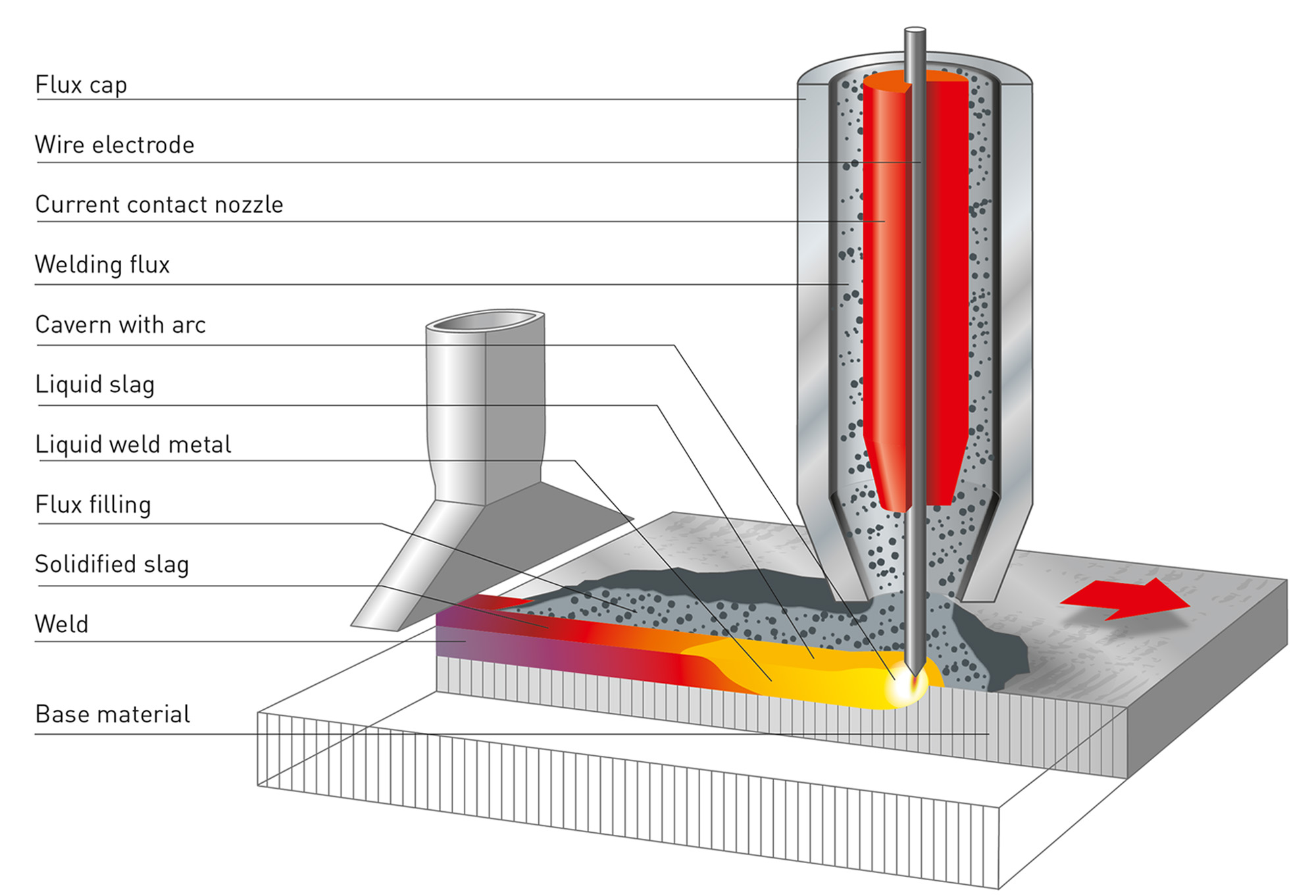
(©Graphic: Kjellberg Finsterwalde)
Submerged arc welding (SAW) is an arc welding process using a continuously fed wire electrode. The arc burns between the electrode and the workpiece and, together with the weld pool, is covered by granular welding flux. This means the arc is not visible during welding. The flux forms a slag layer that protects the weld zone from atmospheric influences.
The flux cover provides high thermal efficiency and enables high deposition rates. At the same time, submerged arc welding delivers high and reproducible weld quality with virtually no welding fumes. This makes the process particularly suitable for long weld seams and applications involving high weld volumes.
Where is submerged arc welding used?
Submerged arc welding is mainly used for thicker components and is economically attractive from a material thickness of around
6 mm. Typical applications include pressure vessel construction, structural steelwork, crane manufacturing, shipbuilding and wind turbine production. The process is suitable both for joining and for applying wear- and corrosion-resistant layers.
Materials that can be welded include unalloyed and alloyed steels as well as chromium-nickel steels.
Due to its high deposition rate, SAW is predominantly used in mechanised or automated applications. High welding speeds and long welding cycles make it possible to produce long weld seams with few interruptions. This reduces non-productive time and supports economical production.
Mechanised and automated submerged arc welding
Submerged arc welding technology can be used, for example, on gantries, welding columns, motorised axis systems or carriages. The modular design of Kjellberg submerged arc welding technology and different carrier systems enables the equipment to be adapted to different components, weld geometries and production tasks.
While conventional SAW systems are primarily used for long and uniform weld seams, modern robotics extend the freedom of movement of the process. This allows submerged arc welding to handle more complex weld geometries and opens up new possibilities for automated production processes.