Robotic submerged arc welding
Submerged arc welding is traditionally used for long, straight weld seams on thick-walled components. Combining the process with modern robotics extends this range of applications. Automated motion control enables more complex weld geometries and allows SAW to be integrated more flexibly into industrial production processes.
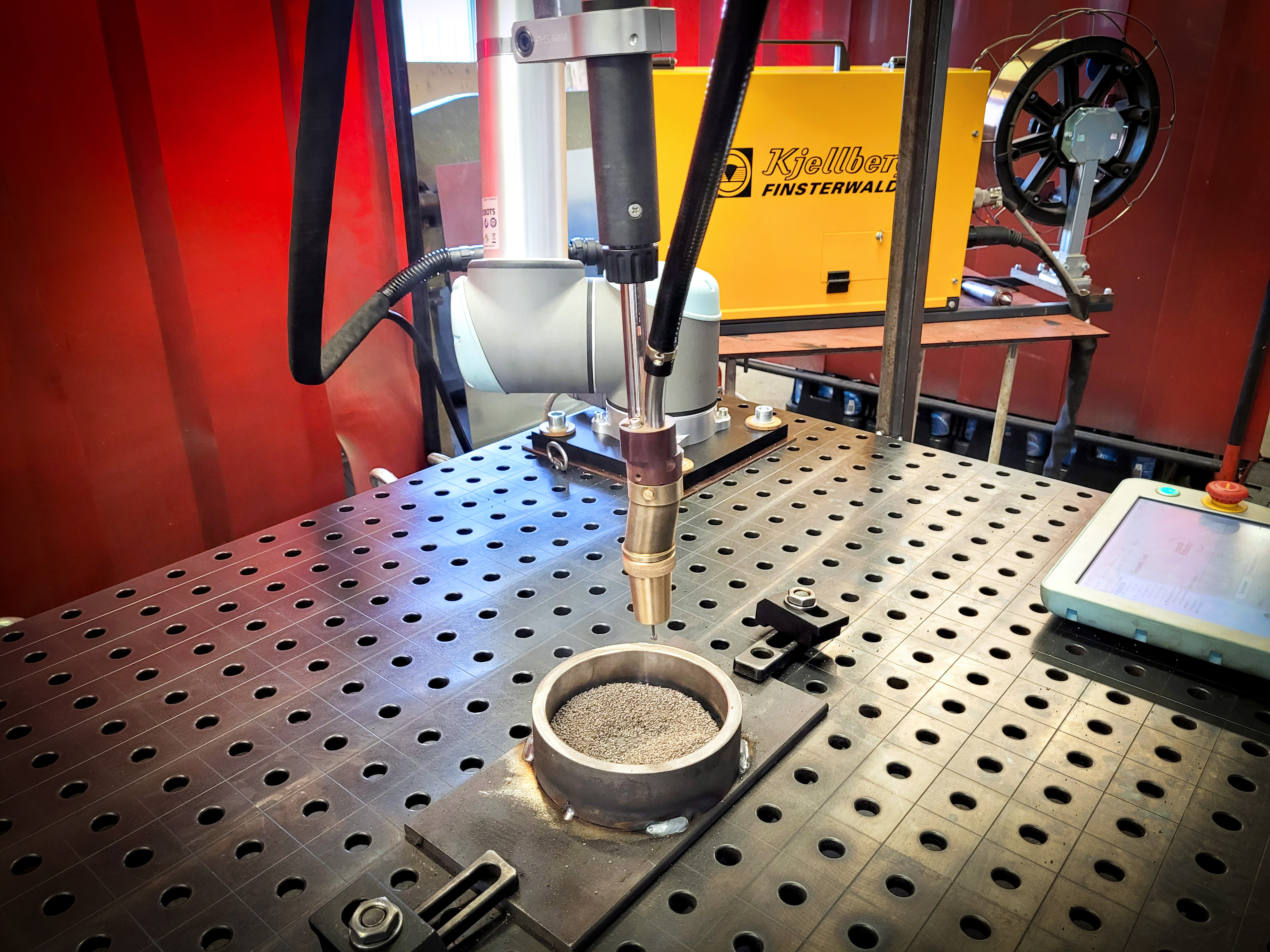
Greater freedom of movement for submerged arc welding
In conventional mechanised submerged arc welding, the guidance system and component geometry largely determine which weld paths can be achieved. With an SAW hand torch mounted on a robot or cobot, however, the torch can be guided along a variety of geometries.
In addition to longitudinal and circular seams, this enables, for example, corner joints, circular seams, contours or components such as door frames to be welded automatically. Submerged arc welding thus opens up applications that can only be realised to a limited extent with conventional submerged arc welding machines.
Kjellberg Finsterwalde has not reinvented submerged arc welding – we have given it greater freedom of movement.
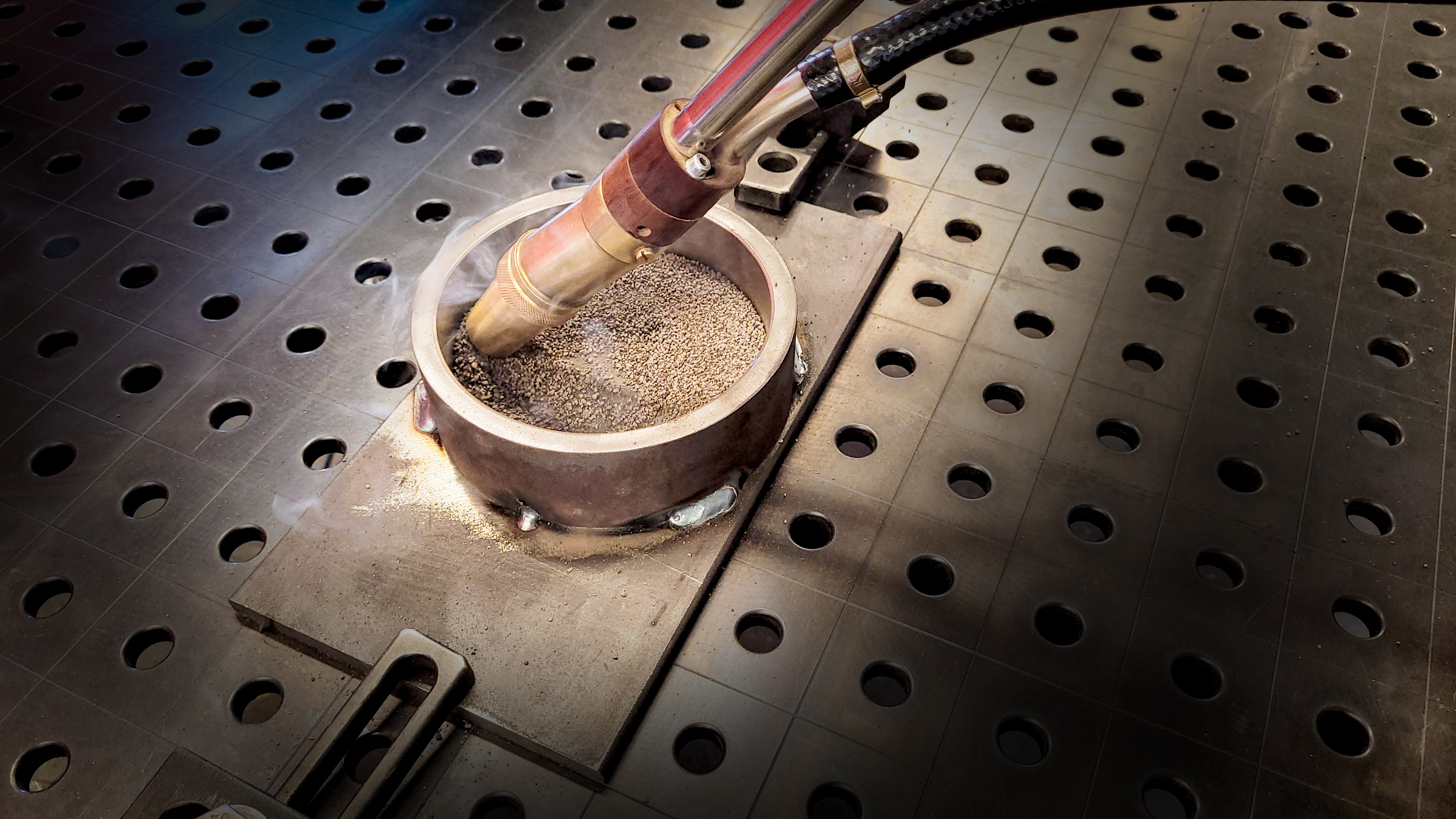
Robotics and welding technology must work together
For reproducible automated welding processes, torch movement alone is not enough. The power source, wire feed, robot control and process control must work together in a coordinated manner.
With the KSI 700 and KSI 1000 inverter power sources, intelligent wire feed systems and coordinated process control, Kjellberg Finsterwalde provides the technical basis for automated SAW applications. Synchronised process parameters support reproducible welding results and consistent weld quality.
Flux handling as part of the automation process
A particular challenge in robotic submerged arc welding is flux handling. While torch movement and wire feed can be automated, the welding flux must also be supplied reliably along the weld path.
In future, flux handling can be further automated and integrated into the process control system.
Automated flux recovery is another development step that Kjellberg Finsterwalde is currently working on.
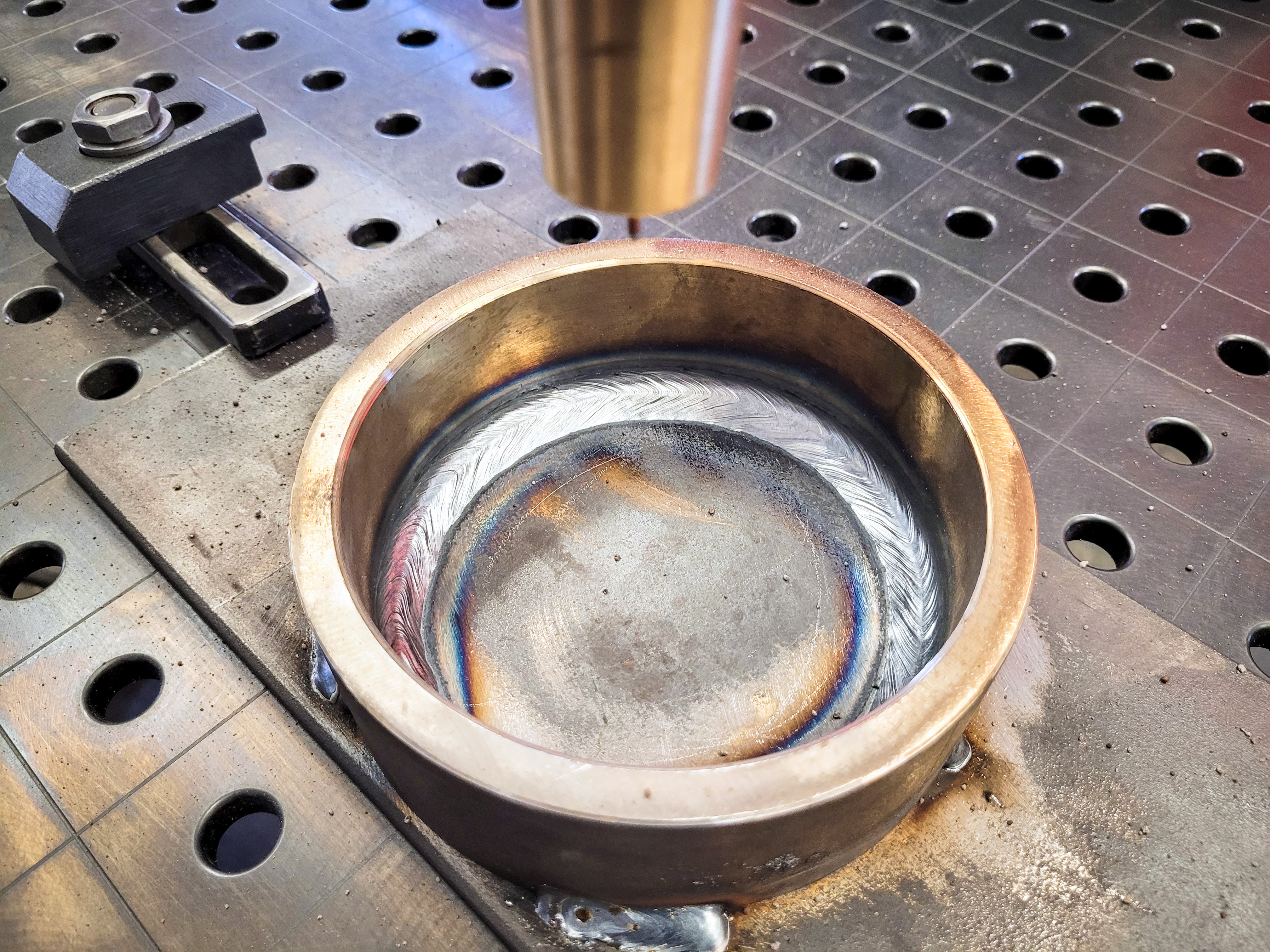
Weld result of a robotic SAW application on a circular seam.
(©Photo: Kjellberg Finsterwalde)
Challenges and limitations
Key technical challenges include precise torch guidance when the welding process is concealed by flux, reliable seam tracking despite manufacturing tolerances, and a consistent supply of flux. With complex component geometries, accessibility, robot movement and slag management must also be taken into account.
Robotic submerged arc welding is not suitable for every welding position or component geometry. It is therefore essential to consider the welding process, component, motion control and automation as an integrated system.
Integration into different robotic systems
Kjellberg Finsterwalde develops its welding technology for integration into a range of robot and cobot platforms. This enables machine manufacturers, system integrators and specialist distributors to adapt automated SAW solutions to existing production processes, components and customer-specific robotic systems.
Further reading
The article “Submerged Arc Welding Reimagined” was published in SCHWEISSEN UND SCHNEIDEN, issue 9/2026. In the expert interview, Sascha Rudnik answers three questions on the technical challenges, process synchronisation and limitations of robotic submerged arc welding.
https://www.schweissenundschneiden.de/artikel/unterpulverschweissen-neu-gedacht